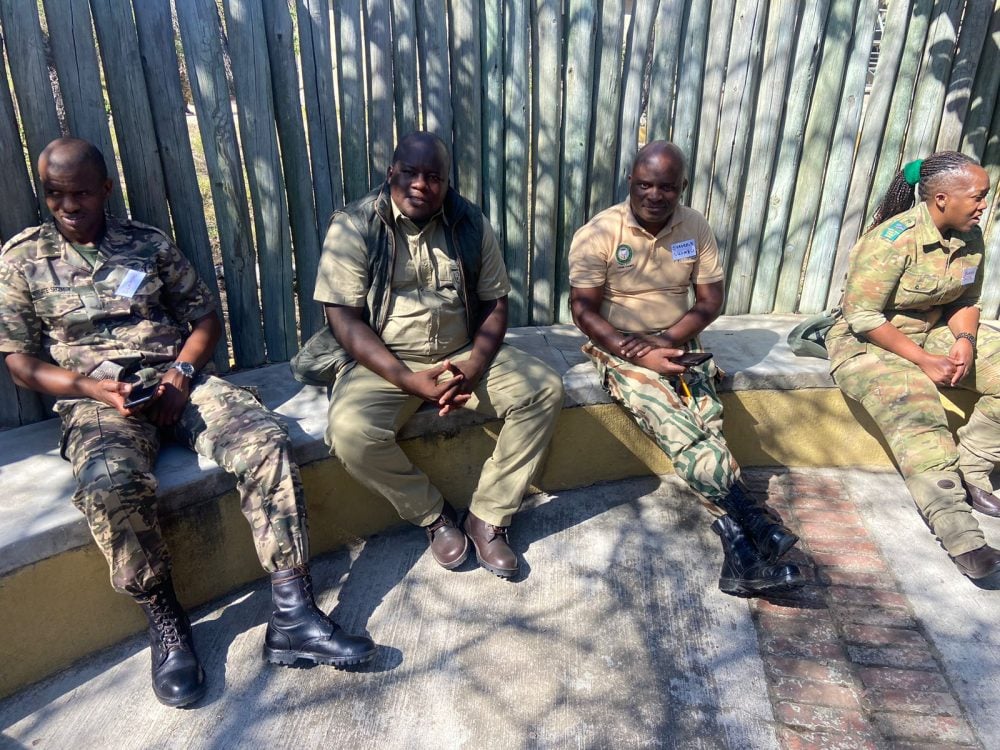
In the far eastern corner of Botswana, where the Shashe and Limpopo Rivers meet, and the borders of three countries fold into one another, lies the Northern Tuli Game Reserve: 72,000 hectares of rugged mopane woodland, sandstone outcrops, and some of the highest concentrations of elephants for private reserves in Southern Africa. It is a landscape of beauty, pressure, and proximity. The reserve shares unfenced boundaries with both Zimbabwe and South Africa, creating an environment where wildlife moves freely, and so do the challenges of protecting it.
Orebotse Rex Masupe, Managing Director of Afzelia (Pty) Ltd, a service company owned by the Northern Tuli Game Reserve Landowners Association, and the architect behind its modern anti-poaching strategy, says this is more than a job. “I come from a community just outside the reserve, about three kilometres away,” he says. “Both my parents worked here when it was still farms. My mother was a cook, and my father helped with anti-poaching efforts, mostly by removing snares. I grew up exposed to the pressures of human-wildlife conflict.”
That early immersion shaped his path. After attending school in Botswana and Zimbabwe, Rex trained as a guide, worked in the Okavango Delta, assisted wildlife researchers, and spent years helping PhD students track predators across Mashatu. He even spent a stint working at Disney World in the United States, an unlikely interlude that never pulled him far from his roots. “Eventually, I came back to anti-poaching,” he says. “Now it’s been nearly 16 years.”
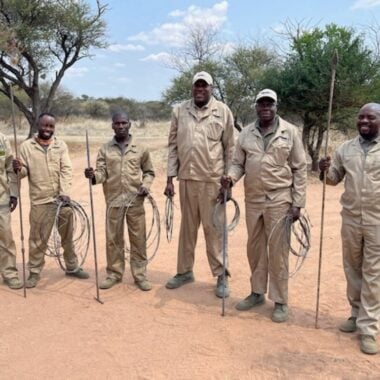
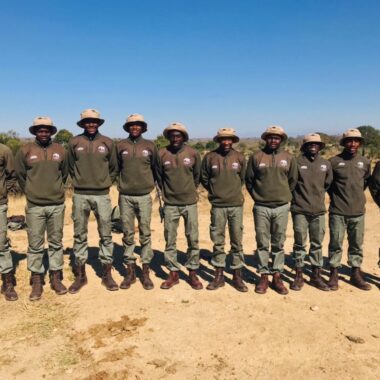
In 2018, Rex led a restructuring of the reserve’s protection system. Previously fragmented teams were consolidated into a single coordinated unit that enabled the reserve to manage its security challenges holistically. “Two teams were doing similar work under different management structures,” he explains. “It created limitations. By integrating the teams, we strengthened coordination and started with 14 personnel.” Today, the unit has grown to around 39 staff members, including gate rangers, fence teams, patrol units, and administrative support.
The reserve’s transboundary location requires close collaboration with neighbouring countries and local stakeholders. “We share extensive boundaries with both South Africa and Zimbabwe,” he says. “This makes cooperation essential in addressing conservation challenges.”
Poaching in Northern Tuli has changed over the years. Historically dominated by snaring, it has shifted towards nighttime incursions, torches in hand, young men crossing the river with dogs, chasing impala or giraffe. The scenes can be brutal. “The other night we had two giraffes that were speared,” he says. “People come at night with flashlights. When you approach at midnight or 4 a.m., dogs are barking, people are butchering giraffes, you don’t see how old they are or who you’re dealing with.”
The reserve responds with caution, community, and legality. Rangers carefully manage crime scenes, call police immediately, and testify as witnesses in court. “Every citizen has the power to arrest,” Rex explains. “When someone is apprehended, we call the cops. The police come, collect evidence, and take over. All the animals in Botswana belong to the state, so charges are for illegal hunting or illegal possession of government trophies.”
Law enforcement alone isn’t enough. Rex works closely with community leaders in both Botswana and Zimbabwe to reduce conflict and prevent escalation. “Sometimes the dogs chase an animal into a lodge, and tourists are up at 2 a.m. while 20 dogs are barking,” he says. “We engage farmers and community leaders so that the bilateral relationship becomes more useful than shooting a poacher.”
His deep, long-term, and complicated connection to the local community has been both a strength and a burden. “It’s difficult to be a cop in a neighbourhood,” he admits. “Sometimes footprints lead to your neighbour. People threaten to burn our houses. But after spending most of my life here, I’m no longer uncomfortable. Eventually, people phone you and say, ‘Rex, someone is selling meat,’ and you go.”
The pressures on the reserve extend beyond poaching. Human-wildlife conflict is a constant concern, especially in Northern Tuli, which holds one of the highest elephant populations among private game reserves in Botswana. Rangers track incursions, monitor fences, and respond to emergencies. “Eight guys handle the 35km fence between the reserve and communal land,” he says.
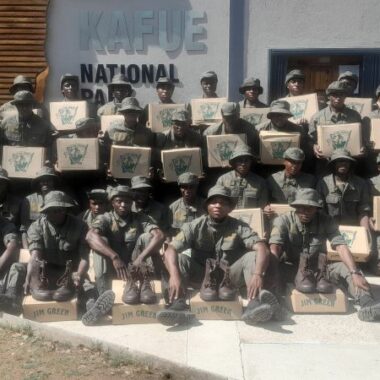
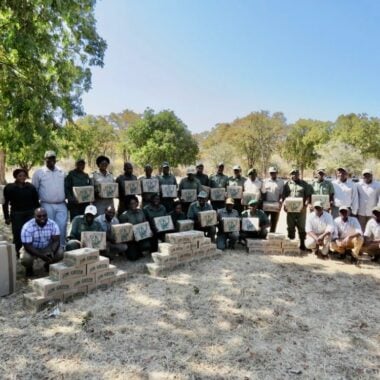
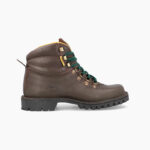
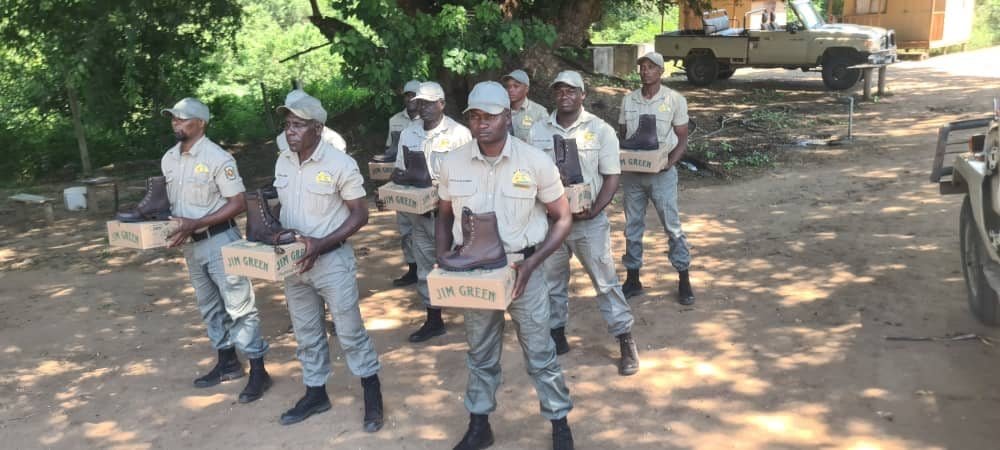
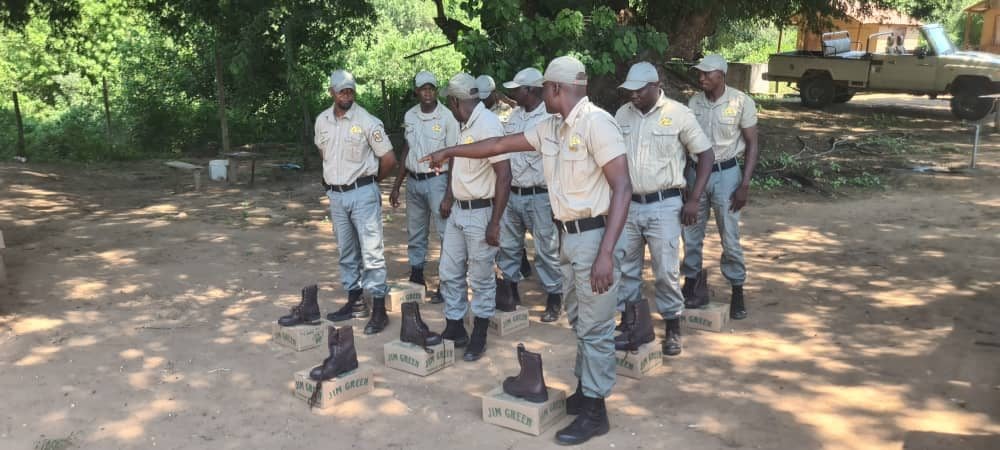
The work is relentless. It’s physical, analytical, political, and dangerous, which is why the right equipment matters. Earlier this year, every ranger in the unit received Jim Green boots through the Boots for Rangers initiative with the Game Rangers Association of Africa. “Everyone got a pair,” Rex says. “It makes a difference out here.”
Northern Tuli is also involved in ambitious species projects, including the reintroduction of wild dogs. It’s a challenging process in a landscape this open. “When I first worked here in 2008, we started with 18 wild dogs from Marakele,” Rex recalls. “We thought we had perfect land, but it didn’t work out. The dogs covered so much distance that they overlapped the reserve. They were moving as far as Mapungubwe.”
Researchers tested a ‘biofence’ using foreign scat along the perimeter to discourage packs from roaming into community lands. “It worked for a while,” he says. “But as the pack grew, especially after 14 pups, they expanded fast. Some went into communal land and died. Human-wildlife conflict made it very difficult to maintain them.”
Beyond field operations, Rex is also actively involved in community education, an aspect he values deeply. Each year, lodges such as Mashatu Game Reserve pause operations for a week to host primary school learners from surrounding communities. During this time, professionals working within the reserve, including Rex, provide lessons and exposure to conservation and tourism.
This initiative helps young people understand the importance of wildlife and the role of the reserve in supporting livelihoods. Nearly 400 people are employed within the Northern Tuli Game Reserve, with approximately 80% coming from surrounding communities.
Yet hope remains. With ongoing conservation planning, cross-border collaboration, and the steady presence of field teams, the landscape offers the possibility of recovery for wildlife, for ecosystems, and for the communities that depend on them.
Rex’s measure of success isn’t just protection, it’s legacy. “I’m not a university graduate,” he says. “I’ve learned from the field and from time spent in it. I’m proud that the entire anti-poaching project is my brainchild and that the landowners trusted me. Seven years on, the company is running properly. It’s a dream that came true.”
Cheers,
The Jim Green Team
Through our Boots for Rangers initiative, run in partnership with the Game Rangers Association of Africa, we donate one pair of boots to a ranger for every ten pairs sold from our Ranger range. These boots are now supporting conservation teams at sites across Africa, with over 10,000 pairs already on the ground.